The Man On The Ice
An essay by Bedford’s award-winning
photographer, Emily Fisher
As a photographer, I am always searching for subjects to shoot. When I travel, they are easy to find; almost everything I see is foreign and new. At home, my subjects are usually my children, our animals, or the bucolic Westchester landscapes that surround us.
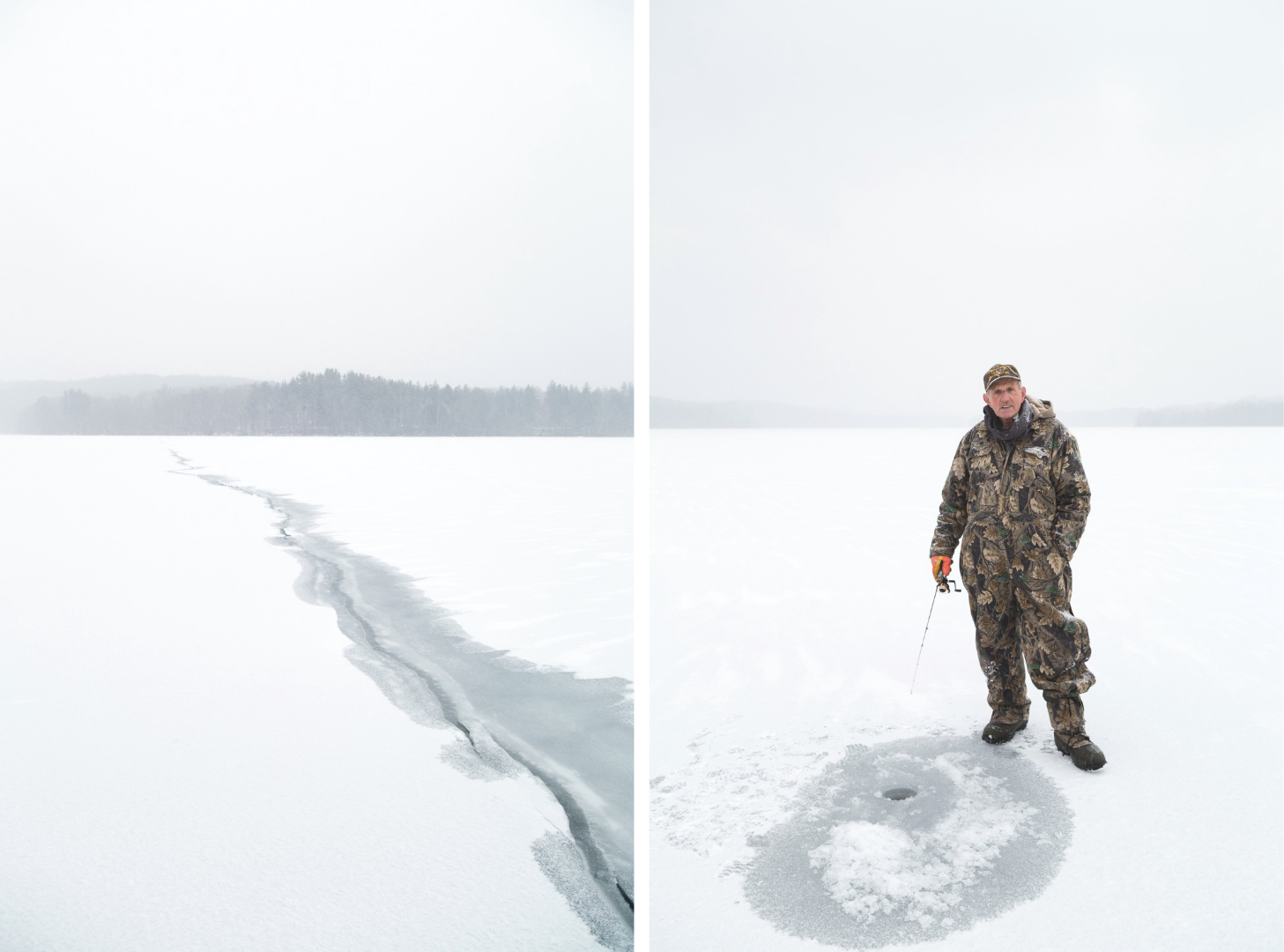
In the winter of 2018, I became intrigued by a group of ice fishermen I’d occasionally seen on Titicus Reservoir, which I passed frequently on my drives to and from our home in North Salem. Ice fishing struck me as an interesting, niche culture right in my own town. I decided I would photograph it during the next snowfall, as I prefer white skies for shoots—overcast, fog, or snow. No sunny days for me.
When the next snowstorm arrived, I suited up, grabbed my camera, and drove to the reservoir. To my disappointment, there was only one lone fisherman out on the ice. It wasn’t quite the scene I’d imagined—no group huddled around fishing holes, no colorful tents or piles of gear—but I decided to make the most of it.
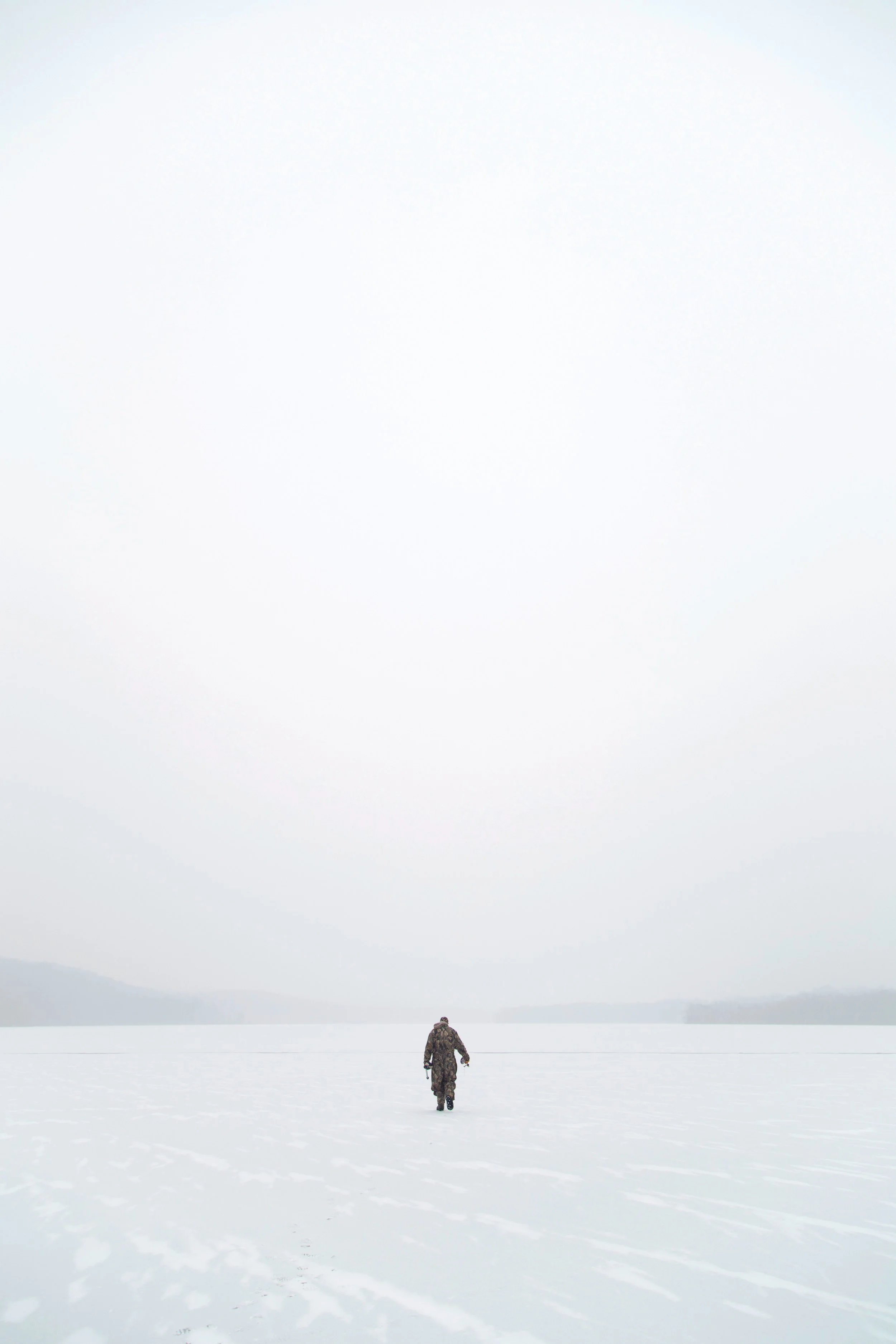
“Hello! Hello!” I called from the frozen shoreline, waving frantically at the tiny, camouflaged figure in the distance. I could have walked out onto the ice to speak to him, but I wasn’t sure it was safe. What if he’d entered the reservoir from another spot where he’d tested the ice for adequate thickness? Standing there in what was essentially a down sleeping bag with sleeves, knee-high winter boots, and a camera fit for the paparazzi, I knew that if I fell through the ice, I’d sink straight to the bottom. Despite my yelling and waving, the fisherman didn’t notice me—or pretended not to.
I finally mustered the courage to take a step… then another. Everything seemed okay. I continued toward the middle of the reservoir, unsure of the reception I’d get. Did he want to be alone? Was silence part of the ritual of ice fishing? Would my presence scare the fish away?
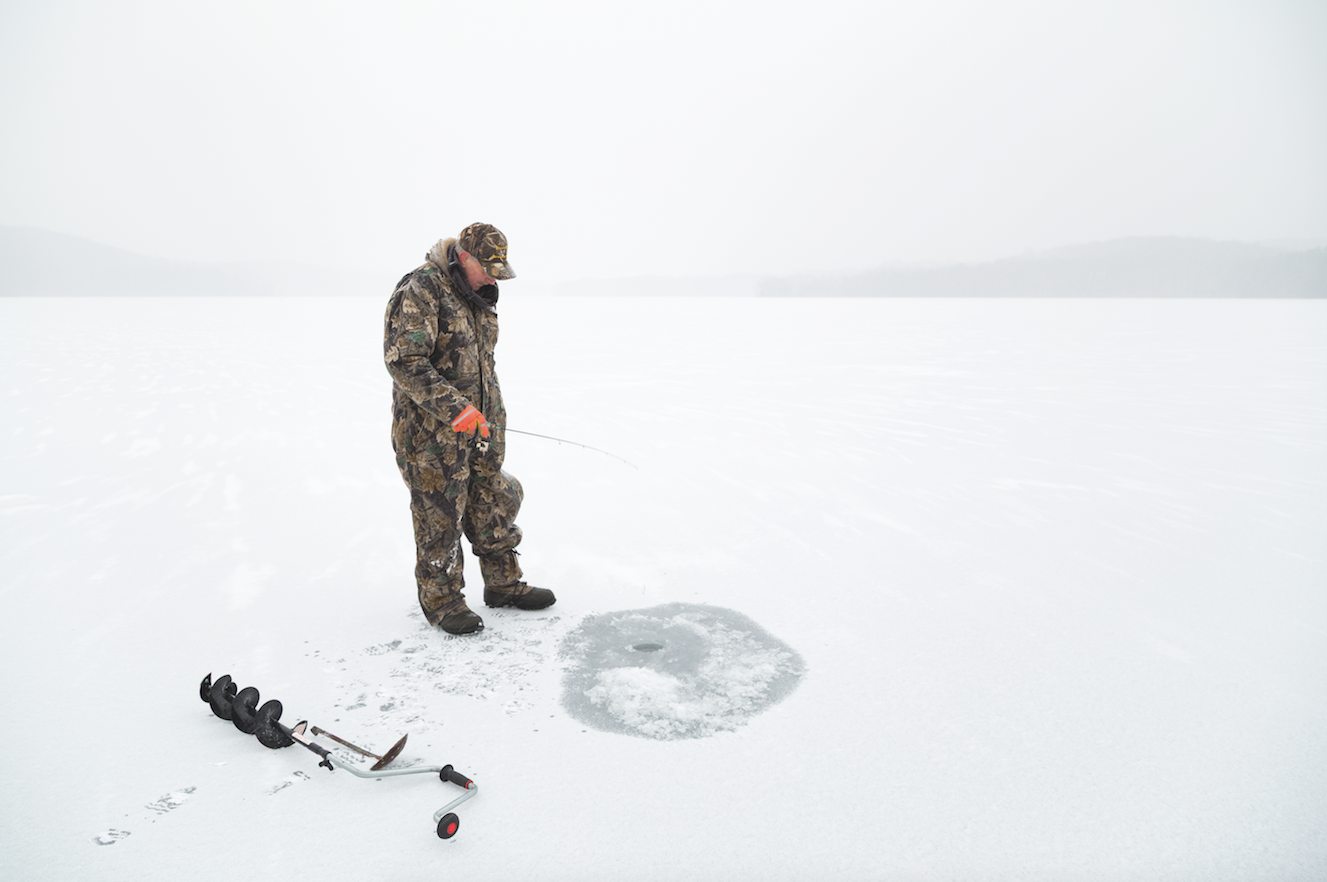
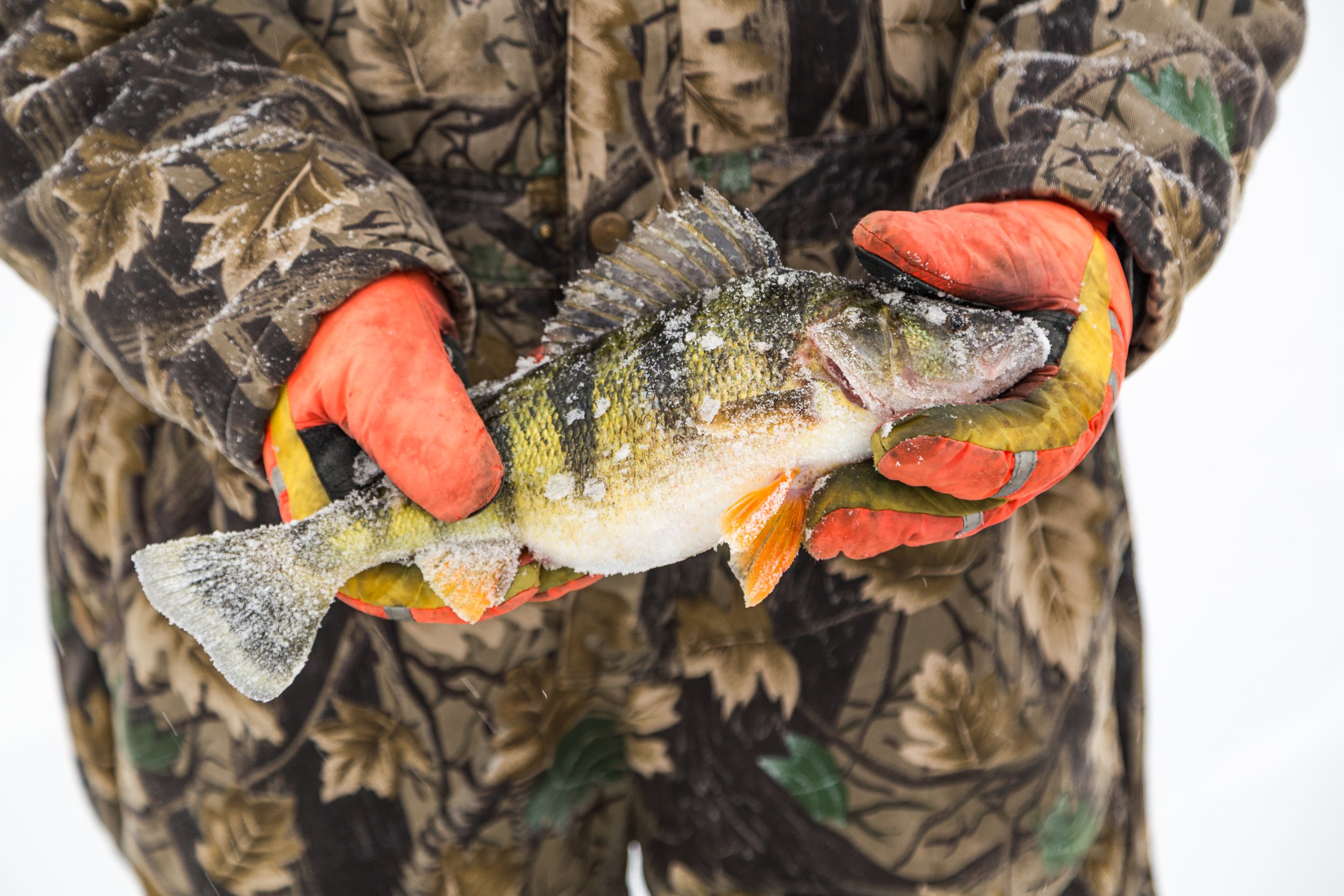
As I approached, I saw that he was older, with kind blue eyes and a weathered face. I explained that I was a photographer and asked if I could take some pictures of him while he worked. He agreed, surprised that I found him an interesting enough subject to shoot. He had been out in the blizzard most of the day and had caught four yellow perch - his dinner for the next couple of nights. Fresh and free. The harsh weather, he figured, kept the other fisherman at home. He explained that each hole held a fishing line connected to a flag that would pop up when it had a bite—no need to sit holding a rod, as I’d assumed.
As we walked around the ice, he told me to avoid a large fissure running the length of the reservoir (that was exactly the kind of expertise I’d been hoping for). I hopped over the dark, icy vein as instructed while he shared that his wife had recently died and that he had been feeling lonely without her. Fishing gave him a sense of purpose and kept his mind busy. He was embarrassed that he’d worn his old coveralls, not his new ones, because he didn’t think he’d see anybody. While I was with him, his daughter called, and he proudly told her that a photographer was taking pictures of him. I felt relieved knowing someone was checking in on him.
I took some portraits of him, shot his gear and his catch, but it was near the end of my visit that I captured the image that took my breath away. He walked to the outer edge of his area to drill a new hole, turned in profile, and began working his large manual auger, his hands gloved in neon orange. I positioned myself so that nothing else was in my field of vision—just him and the drill against the backdrop of a whiteout.
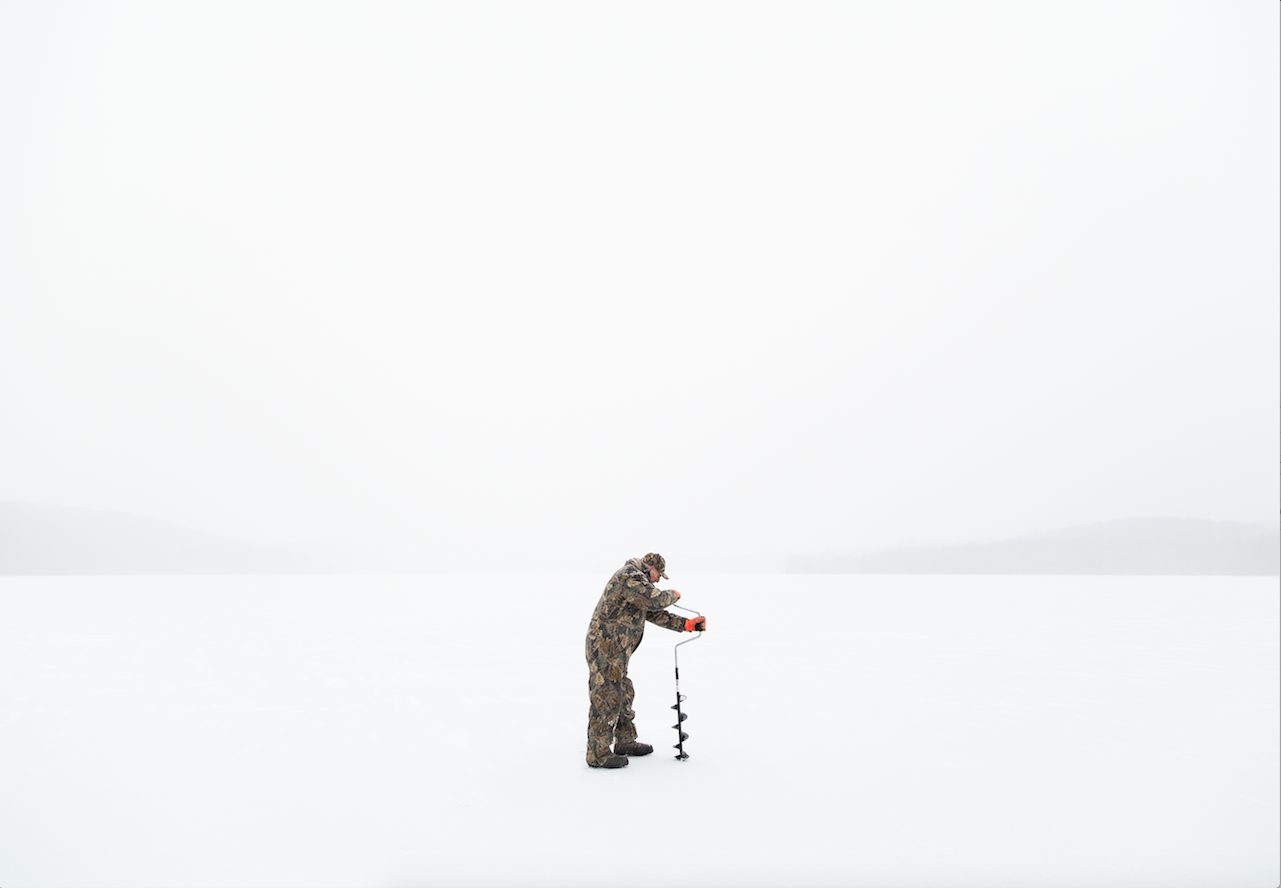
After a couple of hours, I felt I had what I’d come for, so I thanked him for indulging me and went home to upload the images. As an artist, I know when I have taken a strong picture, and I felt a rush of adrenaline when that image appeared on my monitor. It needed very little editing. I couldn’t have staged it better if I’d tried.
Over the next few years, I submitted the photograph to competitions, juried shows, and publications, and it did very well. It was accepted into a juried exhibition, The Edge Effect, at the Katonah Museum of Art in 2019. The following year, it dawned on me that I should tell the ice fisherman about all the places he’d been! He had hung in The Center for Photographic Art in Carmel, California, and the Spiva Center for the Arts in Missouri, among others. He had been published in Art Quarterly, FotoNostrum Magazine, and the Minimalist Photography Awards book. But how would I ever find him? I never got his name, and we had since moved from North Salem to Bedford.
Then I had an idea: I would ask the internet.
I joined the Ridgefield, Connecticut, Facebook group and posted a message with some photos asking if anyone recognized the man I had photographed on Titicus Reservoir. I explained that one of my photographs of him had been exhibited at the Katonah Museum of Art and that I wanted to give him a print. Responses poured in—encouraging messages from people who hoped I’d find him and others tagging friends who might know him. Finally, a man named Jeffrey offered to post my inquiry on the New York Reservoir Fishing page.
The next day, Jeffrey reported back: he had a bite. The fisherman was Roger H. from Putnam Valley. Roger wasn’t on social media, but a fishing buddy recognized him and shared his contact information. Jeffrey sent me Roger’s number, and when I called it, he remembered me immediately. He was surprised to hear about the life the photograph had taken on and said, humbly, “No one’s ever taken a good photo of me.”
I told him I wanted to frame a print for him and asked if I could deliver it in the spring. A few months later, I drove to his tidy, modest home, and we sat outside together on a warm day. He gave me some vegetables he’d grown in his garden, and we talked about life. Before we said goodbye, he hung the framed photograph on his living room wall for me to see.
That’s it—a simple story about two strangers whose paths crossed once and, thanks to the magic of the internet and this community, crossed again a couple of years later. I haven’t seen Roger since, but I like to imagine him still fishing, still hoping to get a bite, still finding comfort and purpose in the ritual. In my photograph, he is suspended in time, steady and intent. His image hangs on walls and appears in magazines and books now, but most importantly, it hangs in his own living room—a reminder that he was seen, even lauded, and that for a moment, his quiet life on the ice was worthy of a museum wall.