
John Jay: Bedford’s Own Founding Father
BY: MICHAEL CURRAN
The pantheon of America’s Founding Fathers is sometimes defined quite broadly as including all fifty-six of the signers of the Declaration of Independence plus some other influential political and military leaders. But most modern historians agree that the list of the seven most important Founding Fathers includes: the first four Presidents - Washington, Adams, Jefferson, and Madison, and Benjamin Franklin, Alexander Hamilton, and Bedford’s own John Jay.
Indeed, Jay may have been the most influential of the Founding Fathers - albeit he’s now the least well-known. He was the second Governor and the Chief Justice of the Supreme Court of the State of New York, and he was the only Founder to play a role in all three branches of the United States government, having served as President of the Continental Congress, the second U.S. Secretary for Foreign Affairs, and the first Chief Justice of the Supreme Court.

PORTRAIT OF JOHN JAY, 1794, GILBERT STUART - GIFT OF THE JAY FAMILY
WHAT DID JAY SAY?...
Being part of the New York elite, Jay was initially inclined to seek conciliation with, rather than separation from, Great Britain. As a member of the First Continental Congress, Jay drafted an Address to the People of Great Britain which suggested a peaceful reconciliation was available if the King would treat his colonial subjects with the same rights as Englishmen, including due process, religious freedom, and trial by jury. By the time of the Second Continental Congress, Jay was a recognized leader of the moderate faction, and participated in drafting the ‘Olive Branch Petition’ to King George III. Receiving no response to these efforts, Jay concluded that separation from Great Britain was necessary and supported the adoption of the Declaration of Independence in July 1776. …And Jay, alongside Franklin, was a principal negotiator of the 1783 Treaty of Paris with Great Britain, essential to securing Great Britain’s recognition of the independence of the United States.
Jay then joined Hamilton and Madison in writing the Federalist Papers, contributing five papers published under the pseudonym Publius to the series. Jay’s papers focused on establishing the rationale for a strong Federal government, rather than a confederacy of states. Jay argued for Americans’ shared identity of geography, language, religion, and history - ignoring the separatist Dutch, German and French colonists. He made the case that a strong Federal government would be less likely to enter into foreign wars and would better deter foreign aggression. He argued against a confederacy of states because it would lead to internal conflict and potential civil war. His final paper focused narrowly on the power of the Senate in foreign affairs relative to that of the President, and the need for the President to have the Senate’s approval to conduct war.
And, perhaps most critical to Jay’s role as First Founding Father, as a member of the New York Provincial Congress, Jay was one of the principal authors of the New York State Constitution…which, among a handful of other state constitutions, became a model for the Federal Constitution. And beyond being therefore generally credited as at least one of the principal proponents of the Constitution - alongside Madison, Jay is particularly noted for having provided checks on the power of the Executive, for prescribing the Judiciary as a co-equal branch of government, and for the sanctity of public voting with secret ballots.
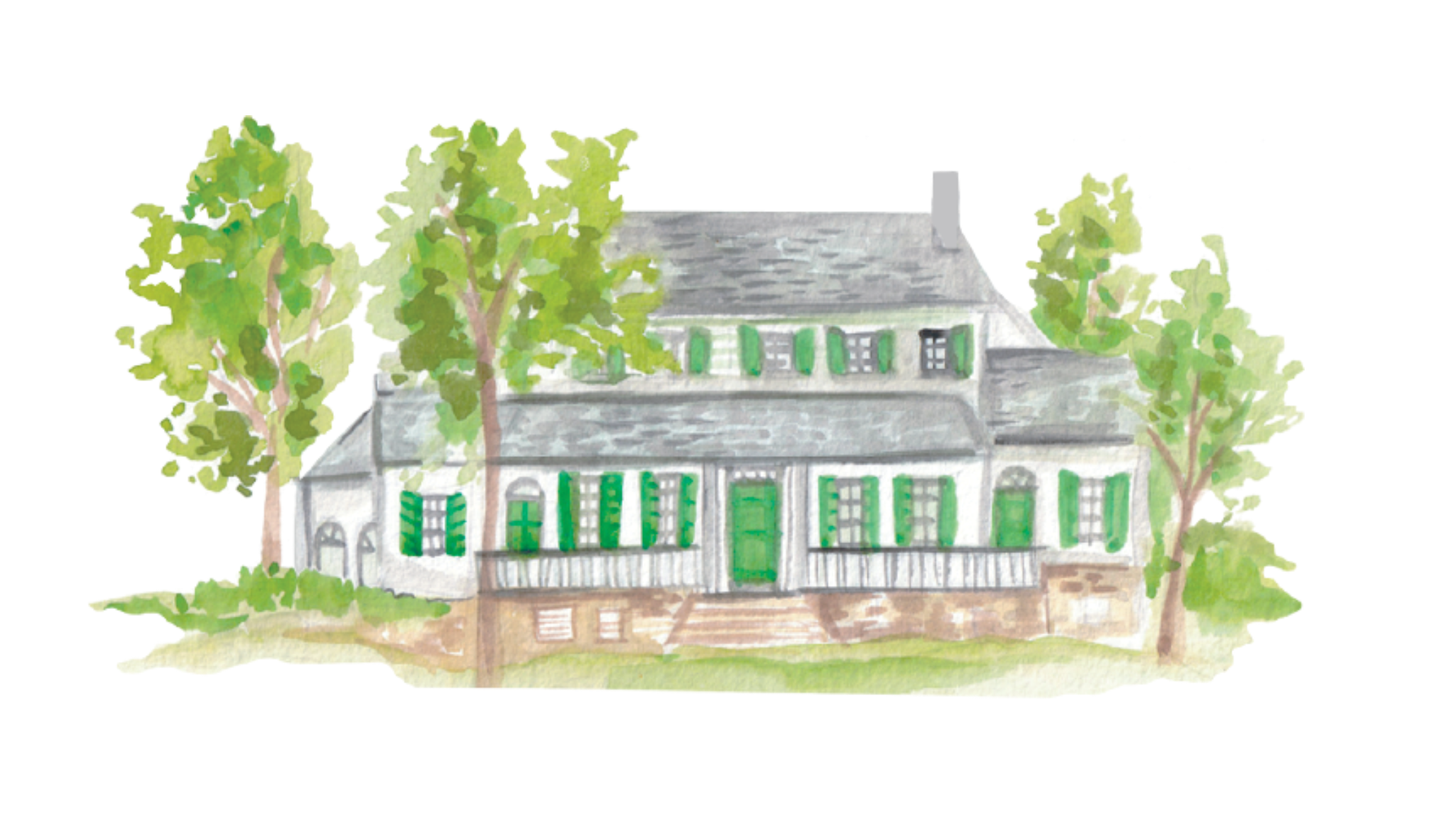
JOHN JAY HOMESTEAD

The Jay family were French Huguenots who fled France when Louis XIV banned Protestantism in 1685. Jay’s paternal grandfather, Auguste, came to Charleston, South Carolina, and later made his way to New York. In subsequent generations, the Jays married into the wealthy and influential Van Cortlandt and Livingston families. The Jays were successful merchants and invested in land in New York City and in areas north of New York – notably in Rye and Bedford. Even as early as the mid-18th Century, savvy investors were seeking out real estate opportunities in what would become Westchester County.
John Jay actually grew up in Rye. He entered King’s College - today’s Columbia University - in 1760, when he was just fourteen. The curriculum was heavily focused on the classics including Greek, Latin, religion, philosophy, and oratory. Jay also studied natural sciences, math, and literature. Importantly, he was exposed to Hugo Grotius’ treatise on international law – a weighty subject for a teenager to ponder, but an area that Jay returned to repeatedly in his career. His career as a lawyer began as a law clerk, and after three years he was granted a master’s degree for behaving ‘soberly and decently’.
Having served his State and his Country continuously for twenty-seven years, Jay finally retired to the life of being a gentleman farmer - at what is now known as John Jay Homestead State Historic Site, in Bedford, in 1801. He’d inherited acreage in Bedford from his mother, Mary Van Cortland, originally purchased by his maternal grandfather, Jacobus VanCortlandt, and then he’d purchased other parcels to create a seven-hundred-fifty acre farm. Then, in 1787, he contracted for the construction of the earliest section of what would become known as Bedford House, and the original edition was completed in 1790, and then expanded when the Jays moved in full-time at the turn of the Century. Jay provided detailed instructions to the builders regarding dimensions, finishings, and fixtures and supervised every phase of the construction. After the house was completed and before moving-in permanently, Jay visited the property to provide direction for constructing farm buildings, purchasing several mills, and experimenting in farming techniques, and Jay took particular interest and delight in the planting of fruit trees.
Jay meant for the house to be one of substance, built with superior materials, but specifically did not want the house to be built on a grand scale. It was close enough to New York for visitors, but far enough away to beg-off on unwanted commitments. Although Sarah Jay died in 1802, Jay continued to enjoy the house, the farm, and regular rides through the countryside for another twenty-seven years before dying at home at the age of 83.
The property remained in Jay family hands until the death of Eleanor Jay Iselin in 1953, and in 1957, the John Jay Homestead Association, led by Otto Koegel, was founded to save the property for public benefit. With the Association’s help, the Homestead became the property of New York State in 1959 and, after some restoration, was opened to the public in 1964.
In the early 1970s, the John Jay Homestead Association disbanded. Friends of John Jay Homestead was founded in 1977 to serve as the State’s philanthropic and programmatic partner, supporting the preservation, interpretation, and public life of the Homestead through fundraising, advocacy, educational programming, and community engagement.
THE RESTORATION
While John Jay is preeminent among the Founding Fathers, John Jay Homestead certainly does not enjoy the venerable status of Washington’s Mount Vernon or Jefferson’s Monticello. The house was and remains well situated on a rise overlooking fields and distant hills, and has a presence that warrants reverence and careful preservation. But a quarter-of-a-millennium is a long time, and the passage of time had taken its toll…and so Bedford House required a total restoration, conducted, of course, with the utmost attention to historical detail and John Jay’s enduring legacy.

Almost ten years ago, with the 2026 two-hundred-fiftieth anniversary of the Declaration of Independence looming large on the American history calendar, New York State and the Friends of John Jay Homestead began planning an ambitious restoration of Bedford House and the surrounding grounds.…with the Governor’s support! In 2022 New York State committed to the project and, represented by Director Heather Iannucci, the State’s Office of Parks, Recreation and Historic Preservation, the State, in partnership with Friends, is planning a comprehensive studs-out rebuild of Bedford House, including the addition of seven newly interpreted rooms, all with period components and techniques and authentic furniture and furnishings.
In 2024 when construction was initially bid and the cost was greater than estimated, it was determined that the State would not be able to include a complete landscape restoration within the scope of its plan…so long-time Friends of John Jay Homestead supporter Martha Stewart responded to the call and took on the role of Chair of the Homestead’s Landscape Committee - with the intention and commitment to restore the grounds of John Jay Homestead to the monumental condition and vaunted status that it deserves. Meanwhile, New York has recently rebid the Bedford House restoration and the project is moving forward.
While many in the neighboring communities know and love the Homestead for the Farm Market - which will return from its temporary location in Katonah upon completion of the restoration - fewer know about the restoration plans in store. This is something Friends hope to change.
Friends of John Jay Homestead President, Caroline MacGill, notes that “We’re extremely grateful for the State’s commitment to the restoration of Bedford House, thankful for Martha’s amazing support, and totally appreciative for the many people whose vision and hard work have brought us to this moment—especially that of our former Executive Director Emily Grand, whose leadership helped lay the groundwork for this restoration, and the generations of Board members, volunteers, and supporters who have championed the Homestead for nearly fifty years.”
MacGill continues, “New York State’s investment will restore the historic house itself, but fulfilling the full vision for this local gem and national treasure will require both significant private philanthropy and support from our community. Millions of dollars are still needed to restore the historic gardens, outbuildings and landscape, to complete the house’s authentic period interiors and furnishings, to return important archival collections ‘home’, to expand educational and civic programming such as our newly conceived debate association, and to create the kind of visitor experience this extraordinary place deserves. Returning John Jay Homestead to its rightful place among America’s great historic sites will take all of us—New York State, the Friends, and the broader community—working together to ensure that this place, and the stories it holds, remain accessible and inspiring for generations to come.”
